Pages

Showing posts with label ethnography. Show all posts

7.5.12

News from money games research

India, Korea and - gambling. Those have been the three subjects of my research for the last five years. The connection between the three in my research has been the fact that they have dealt with the new media culture. In India I studied mobile phones, in Korea mobiles and internet, and in gambling especially online poker. My gambling culture research received a boost a few weeks ago when I got a grant from the Finnish Foundation for Gaming Research. According to my research plan, I will eventually write a book about online poker as a cultural phenomenon. The book will include most of my research up to date, extended revisions of my columns for Poker Magazine and Pokerilehti as well as a year-long online gaming diary of a gambling rookie - me. In the meantime, if you are interested in gambling research, you can read one of my latest publications on poker.
I will also give a presentation about my recent studies (including the themes of my upcoming book) on online poker at Nordic DiGRA 2012 in Tampere, Finland in June as well as at the 9th European Conference on Gambling Studies and Policy Issues in Loutraki, Greece in September.

Moreover, a chapter by me and Dr. Perpetual Crentsil titled Ethnography on Immigrant Gambling and Online Poker for a book edited by Prof. Pauliina Raento will come out this summer by Gaudeamus.

And for the last issue of this update, I will (finally) revise and resubmit my manuscript for Visual Culture and Gender. The text is titled Signs of Battle and Joy: Observations of Gender in Online Poker Imagery and will analyze poker advertisements in the Finnish edition of Poker Magazine as well as apply Jean Baudrillard's and Umberto Eco's views of hyperreality while at it.


24.4.12

Back from India!

Our daughter at the feet of a Jain holiness.


I'm back from my 5-month ethnographic fieldwork trip to South India collecting data for our Mobile Communication, Gender and Development project. I've got plenty of interesting observations and interviews thanks to my efficient research assistants and interpreters as well as friendly villagers of Villupuram district. Despite the abundant but sometimes annoying flora and fauna as well as the quirkish forces of nature including Cyclone Thane rummaging through our neighborhood, the fieldwork was a success.

At the moment I am going through my field notes and interviews for some articles and conference papers. In June I will present a paper titled “It’s like a third arm!” - The Cultural Meanings of the Mobile Phone in Rural South India in the IV STS Italia National Conference titled "Emerging Technologies, Social Worlds" in Rovigo. [ABSTRACT]

At the food market.

I will also start working on an article similar to that presented in Rovigo but for a special mobile communication culture issue of Suomen Antropologi: Journal of the Finnish Anthropological Society. The article is titled Can the Subaltern Woman Speak on the Phone? The Social Value, Cultural Meaning and Gendered Use of the Mobile Phone in Rural South India. [ABSTRACT]


Also, a conference report titled From a Workshop into a Network: India Researchers Unite written by Dr. Mari Korpela from University of Tampere and I was just published by Suomen Antropologi. [READ]

The temple next door.


8.4.09

Could a Robot Replace an Anthropologist?

LiveScience (2 April 2009) reported about Adam the Robot Scientist of Abersystwythin University succeeding in creating and confirming a scientific hypothesis without human intervention. Adam predicted that in baker's yeast there are certain genes for specific enzymes encouraging biochemical reactions. The robot then ran experiments in its laboratory to test the hypothesis and analyzed the results.

Although hypothesis-producing robots are an "age-old" invention (since 2004), Adam is special because it can handle independent and automatized laboratory work. According to the computer scientist Ross King, in the future robots will become more widely applied as assistants in the routines and less-interesting tasks of laboratory scientists.

Now when do we anthropologists get our hypothesis-producing robots?! I would love to co-write an article with iMalinowski or Android Appadurai. Or, to get back on Earth, if a cyborg anthropologist is a tall order, it would definitely be interesting to use a robot in the field of, say, urban ethnography.

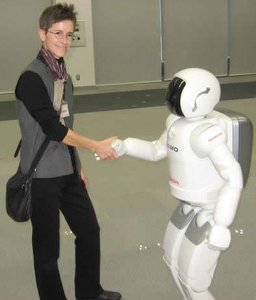
I can easily imagine an interactive robot such as the ones wondering around Incheon Airport, South Korea (see pic left) programmed to do participant-observation and interview people in a public space. Obviously, serious scrutiny of the method would be required but if low-cost and discreet robots were to be produced in the future, I'd see no problem in hiring a few. It would be fun too!


However, if robot-ethnographers are yet to take over, there is fortunately a lot of mixing between anthropologists and robots going on already. Many anthropologists such as Jennifer Robertson (Univ. of Michigan) and Kathleen Richardson (Univ. of Cambridge) are studying the human-robot interaction with fascinating results. It's definitely one of the major fields of anthropology's future!

So, if for now I can't enjoy the help of an ethnographer-robot I can at least study the emerging field of humans mingling with robots.


Read the LiveScience article on Adam here. See also the Mbnet article on the same in Finnish. Pic sources: Robot at Incheon Airport by Jukka Jouhki; Robertson with Asimo from antropologi.info (article orig. from The Daily Texan).