Perhaps because of the strange combination of being a cultural anthropologist studying online poker, I was invited to give a talk to a group of journalists from The Finnish Association of Science Journalists and Editors on an excursion in University of Jyväskylä. I talked about how cultural anthropology can approach online poker as a cultural phenomenon. Below is an edited summary of my talk.
Life is a Gamble
First things first. Every day we invest our resources, money, time or effort in objects, processes, happenings etc. the outcome of which is not sure to us. We might pay 8 € for a movie ticket and regret it afterwards because the film wasn't worth it. We might take time to go for a walk in a park and end up soaking wet because of a downpour and wish we had stayed home watching TV. Then again, we might take a chance and go to a restaurant, pay only a few euros for a meal and think the atmosphere, company and taste of the food were ten times worth the money and the time we paid.  |
| Dice is life (source Psychology Today). |
On a larger scale, we might take a leap of faith and get another job, sell the house and go abroad for a year, or meet a girl, get married and have five kids and think it was all worth the trouble - or not. It is all a gamble. And you can get hooked too. You might go overboard with your jogging, eating, painting or work and be satisfied by the return, end up spending all your money and/or time on it and neglet your friends and family. If you are skillful and level-headed enough, you might cope very well with all the elements of chance in your life, estimate the risks, control your time-use and take action accordingly - and end up living an exciting and fulfilling life. If sometimes you end up losing your bet, you might still think it was worth the shot.
In a way life is like poker. Or, poker is a crystallization of the elements of chance and skill and investment and turnout, in life.
New Anthropology
When people think anthropologists are like Indiana Jones I hate to correct them. Dr. Jones is actually an archeologist but archeology and anthropology do have some things in common. Although archeology concentrates on past cultures and societies it usually examines them in some excotic location like anthropology has traditionally done. The object of research of both disciplines also connotes otherness, non-Westernity and certain strangeness - something that is not "Us".
 |
| Dr. Indiana Jones (source Hollywood.com). |
However, contemporary anthropology is open virtually to all phenomena, new or old, ours or theirs, and fieldwork is increasingly done in one's own native society. The themes that anthropology has always studied, the everyday stuff like marriage, religion, working, pastime, rituals etc., are still studied but extended to include the whole world, not just the remote tribes. I would even dare to say there is no possible thing in the world that couldn't somehow be approached as an object of anthropological research.
"Anthropology can study anything?" my father once asked (perpetuously wondering what an earth I'm doing for work). "Yes, anything," I answered. Then he provokingly asked if going to the toilet, or defecation, could be an object of study in anthropology. I said, actually, it would be a great object of anthropological research. The function is universal but the tradtions vary in different cultures. There are strict rules about when, where or with whom to do it and how to speak about it and what to do with the results. Anthropology is about shared significances, worldviews, actions and norms, or in a word, cultures.
Cultures like online poker.
Approaching Online Poker
The first thing I noticed about online poker research was that it is essentially a problem. At least this is the feeling one gets while browsing through published literature: online poker = addiction = problem. That is what scholars get money for and that is what the media write about and people read about - poker-players as addicts, home-breakers and money-squandering losers. To me it is as strange as it would be to study jogging and focus only on strains or stumbling, or to do research on food and concentrate only on choking accidents, or to approach sex only through venereal diseases. To be fair, not all media does this though. There are all the specialized poker media that endorse poker culture and celebrate its heroes.
Thus it seems like these images are the only ones about poker in media and academia.
Thus it seems like these images are the only ones about poker in media and academia.
 |
| Poker champ/addict (sources Miscellaneouspics and Makefive). |
I think it is time to get to know the Everyday of online poker and see what happens among the usual, normal people, the over 95 % who are not champions or addicts. I want to know the boring side of poker. For example, a case study of mine about a poker-player and his family certainly revealed refreshingly undramatic things about the game. The main informant, a civil servant with wife and kids, earned a considerable amount of money a month. It helped the family a great deal with rent and other monthly expenditures, and even left some money for a holiday trip - things that weren’t possible without the father's poker hobby. And the father still had time for work, kids and the wife. This is how it usually goes. What a discovery!
I had another very obvious but forbidden observation. My main informant's qualities as a succeful poker player were desirable qualities in other sectors of life as well. Logic, contemplation and self-restrain, just to name a few, didn’t do him harm in work or family life either. All in all, poker was present in the family but in a positive way. Even the wife applauded her husband for doing something fruitful in his pastime. The wife said she only watched television, which never brought the family a penny.
I had another very obvious but forbidden observation. My main informant's qualities as a succeful poker player were desirable qualities in other sectors of life as well. Logic, contemplation and self-restrain, just to name a few, didn’t do him harm in work or family life either. All in all, poker was present in the family but in a positive way. Even the wife applauded her husband for doing something fruitful in his pastime. The wife said she only watched television, which never brought the family a penny.
These observations from the case study were welcomed by the media as "exceptional results" and often denigrated by the poker community because the results were too obvious - most people played poker without problems. Obvious or not, poker is a culturally loaded subject and traditional anthropological themes are easily and fruitfully transferred to study it. For example in my research I have distinguished four interrelated M’s — morality, marginality, masculinity and money — that are particularly interesting to an anthropologist.
- What is the cultural configuration in which the morality of poker manifests?
- What are the sociocultural elements that marginalize poker as a hobby or profession?
- What makes online poker representations a hyper masculine venture?
- What is the social and symbolic value of money in poker?
 |
| Serious pokermen (source PokerBonus). |
Everything so far implies that poker research and gambling studies in general need more information about the everyday practices. Is mainstream anthropology up to the challenge? Maybe not for a long time. First the discipline should get to know things like television, then perhaps the Internet and mobile phones. Then, if it is still up to it, online gambling could be studied in anthropology.
Or, one can take a chance and go for a short cut.


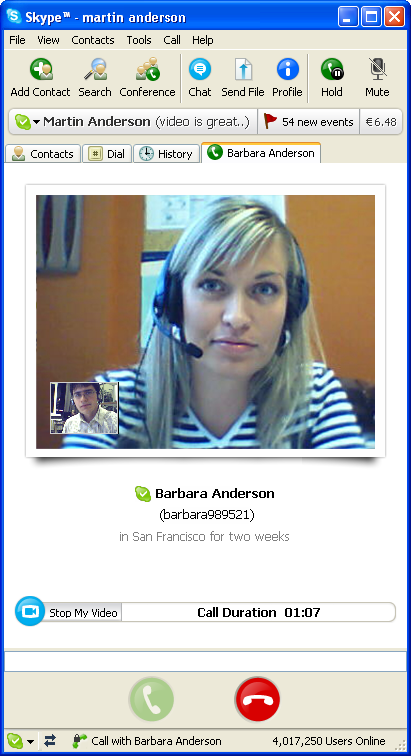

 Although the new technology is cost-effective, the cost is also a problem as only big multinational companies can invest in high quality videoconferencing. Another choice, as also mentioned in the news report, is to rent the equipment.




 Posts


