Pages

Showing posts with label ethics. Show all posts

17.5.10

A Game of Money, Skill or Threat?


The annual conference of The Finnish Anthropological Society was held last week (May 11-12). This year's theme was Ideas of Value: Inquiries in Anthropology. The immensely active Finnish Foundation for Gaming Research sponsored one session named The Value of Gambling (Research), including my presentation about moral views about online poker. Professor Pauliina Raento concluded the session by talking about the significance of gambling/gaming research.

The other three presentations were exceedingly interesting. Riitta Matilainen's (Univ. of Helsinki) presentation The Introduction of the Roulette and the Changing Culture in Finland in the 1960s and 1970s described how roulette for Finns was not just a game but a prestigious symbol representing Finland's pursuit of western values. Perpetual Crentsil's (Univ. of Helsinki) The Good, the Bad and the Money explored the gambling cultures of African and Asian immigrants in Finland. Jani Kinnunen's (Univ. of Tampere) The Social Value of Gambling Online could be described a more hardcore sociological or philosophical investigation of online gambling.


All abstracts of the conference can be read here (go to p. 6 for the gambling session abstracts). Below is my abstract for the paper A Game of Money, Skill or Threat? Reflections on the Ethical Discussion Concerning Online Poker in Finland. Check out the presentation slides here.

Finland’s Slot Machine Association (RAY) is a state-run gambling organization that will launch an online poker service for Finns in 2010. This paper describes and analyzes the ethical discussion provoked by an article in Helsingin Sanomat (the leading national newspaper) on the issue, and considers the various moral viewpoints taken of RAY as an online poker service provider, as well as discussing online poker as a wider contemporary phenomenon.


Image sources: Conference logo grabbed from the home page of The Finnish Anthropology Society and the other pic from Daily Mail online version.

17.12.09

Update on my research: manuscript on poker ethics & chapter on Korean cybernationalism

A few recent fruits of my academic tree.

'Game of threat and money: Notes on the ethical discussion concerning state-run online poker service in Finland.' Proposed to be published in Journal of Gaming and Virtual Worlds 2 (2). (Under review, please do not quote.)


Abstract: Finland’s Slot Machine Association (RAY) is a state-run gambling organization that will launch an online poker service for Finns in 2010. This article describes and analyzes the ethical discussion provoked by an article in Helsingin Sanomat (the leading national newspaper) on the issue, and considers the various moral viewpoints taken of RAY as an online poker service provider, as well as discussing online poker as a wider contemporary phenomenon.

Please feel free to comment on the manuscript here or by email!


'Dokdo Island Dispute: Korean Reconstruction of History and National Identity in User-Created Content Media.' In Digital Memories: Exploring Critical Issues, edited by Anna Maj & Daniel Riha, published by Inter-Disciplinary Press, 2009, pp. 179-187.

Abstract: Japanese colonization of Korea (1910–1945) had an immense impact on Korean society and culture, and on a symbolical level, on what being Korean means today. The traumas of colonialism are still being widely discussed in Korea and there are certain key discursive nodes stemming from the colonial history that present Korea‟s concerns of contemporary Japan-Korea relations.

One of the discursive nodes is Dokdo (which the Japanese call Takeshima), a small and remote rocky island between the two countries in the East Sea (which the Japanese call the Sea of Japan. Both Japan and Korea lay claim to Dokdo, and both claim a long historical and geographical connection with the islets. In addition to traditional media, both have harnessed the cyberspace to support their cause. As both countries seek support from the international audience, the amount of Dokdo-related websites and online news in English is relatively high. Thus, the issue has turned from a small border dispute to a rhetorical fight between two nationalisms that use historical evidence to buttress their claims. The purpose of this paper is to examine how Koreans represent Dokdo, a disputed island in the sea between South Korea and Japan, to an international audience in user-created content media such as YouTube and Facebook. Moreover, the paper analyzes the ways the dispute is further used to reconstruct the history of South Korea and strengthen the national identity of Koreans. Theoretically, the paper refers to Anthony P. Cohen‟s analysis of the symbolism in community making as well as Benedict Anderson‟s thoughts on nations as imagined communities.

More information about the conference on which the book is based in my earlier post here.

5.3.09

Copy Right or Wrong - The Pirate Bay Case and Mind Games

The Pirate Bay is a Swedish website that tracks BitTorrents. It has to do with sharing files.

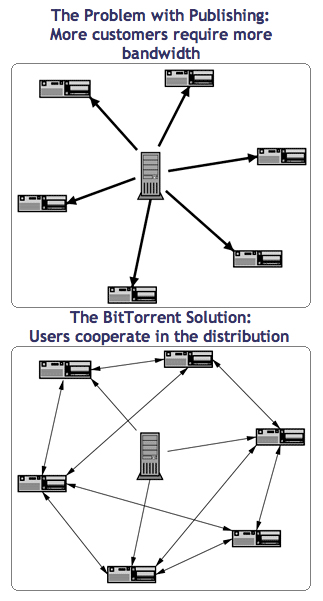
A traditional model of file sharing has Mr. X downloading a file from a server. If many people are after the same file, the server must have a bigger capacity.

A BitTorrent is a protocol that makes sharing files faster and lighter, and it works like this:

Mr. X wants a file likeavirgin.mp3. He goes to a website that tracks BitTorrents. He enters "Like a Virgin" in the search box and gets a list of the available torrents. He clicks one of them and starts to download likeavirgin.mp3 simultaneously from numerous individual sources. While downloading the file he automatically starts to share it with other users too.
In The Pirate Bay everyone can upload and download torrent files. In other words, Mr. X can inform the website about a link that leads to his file likeavirgin.mp3. Other people may inform the website about the same file too. Hence, one link (torrent) in The Pirate Bay may lead to many similar files. In a way The Pirate Bay is a directory of links to individual files. The website per se does not produce any files other than the torrents. No copyrighted material exists in the website's server.

Media companies such as Sony and Warner Bros. have sued The Pirate Bay for copyright theft. Or, to be more exact (as the BBC reports) the owners of the website are accused of "promoting other people's infringements of copyright laws" and the movie, music and video games industry are seeking for compensation (10.6 million euros) "in damages and interest for losses incurred from tens of millions of illegal downloads facilitated by the site." The Bay people, on the other hand, say it's like being sued for making cars that can go faster than the speed limit.

The court case seems to be about two ethical issues. The more obvious is about copyright and the other is about responsibility. It seems like both parties agree on the definition of copyright being "a form of intellectual property which gives the creator of an original work exclusive rights for a certain time period in relation to that work, including its publication, distribution and adaptation." No one thinks Mr. X is allowed to upload or download likeavirgin.mp3.

The big question is whether The Pirate Bay is responsible for publishing a directory of links of which some lead to likeavirgin.mp3 in Mr. X's, Y's and Z's personal computers and, thus, to copyrighted material.

Hard to decide?
Let's try mind games.

Imagine a library with some of its clientele photo-copying some books and thus infringing copyright. Then imagine a book publisher suing the library for aiding violation of copyright. Who do you think would win the case? Would you rather recommend the publisher to sue the copyists instead of the library?


If you would still prefer suing the library, let's go further in the mind game.

Imagine a building just like a library but with the exception of there being no books in the building. Imagine Mr. X. going into the building and asking the librarian if he knew where to find Jonathan Zitrain's The Future of the Internet - And How to Stop It. The librarian would take a look at a list and give Mr. X. the address of Mr. Y. who has the book. Then Mr. X. would go to Mr. Y. and photocopy the book - and infringe copyright.

Would you still charge the library?
You would?
OK then.

Imagine the same library without the books and without the librarian. The only thing that the library would contain would be a notice board where people could post their addresses and the titles of text they possess, whether they be self-written poems, theses, shopping-lists, jokes or copyrighted books. Then imagine Mr. X. going to the notice board and finding the address of Mr. Y. with Zitrain's book.

You could still think the library is the one to blame. And that would be perfectly sound. Perhaps a lot of your judgement would depend on the answers to these questions:

  • How many of the texts listed in the notice board are copyrighted?
  • Is the library aware of the potential copyright infringement enabled by their notice board?
  • Is the library making money out of it?
  • Is the sole purpose of the library to aid copyright infringement?

Or you could as easily make up different kind of questions leading to the opposite moral judgment. You could ask...

  • Is the library itself making copies of copyrighted material?

...and answer no, it is not - and call the case closed.

Eventually copyright is a cultural phenomenon par excellence. It has always been an intriguing ethical issue and the digital age makes it even more so. It seems like the rapid progress of digital technologies makes it very hard for strict copyright to exist. Especially if the counter-sharing technologies and the law-making processes are not able to keep up with the development.

Imagine the year 2050. Will we laugh at the ancient practice of having to pay for likeavirgin.mp3 as all possible public digital data is accessible free by anyone or will the digital pirates be the last outlaws of the world hunted down by the all-seeing media industry/police force complex?


Pic sources: The two modes of file transfer from Bruce’s Journal, the pirate bay symbol from P2P ON!, the library from Southeastern Illinois College, "Captain Copyright" from http://media.canada.com/canwest/143/, Communication from Equalitec.

18.12.08

Lecture: to be a citizen in u-Korea

Yesterday I gave a lecture for the Master's Program of Civil Society Studies at University of Jyväskylä. I talked about the role of the citizen in the South Korean ubiquitous society vision. See the slides here.

Brief points of the lecture:
  • Korea is a country of Big Projects: u-Korea is one of them
  • Technonationalism helps to create a positive spiral of enthusiasm to clear the path towards u-Korea
  • u-Korea vision is TOTAL, meaning that, at least in rhetoric, it changing the whole society in a revolutionary way
  • The emotional value and anthropomorphization of technology are unique to the Korean vision
  • Ethical discussion of the issues of intimacy, control and surveillance in u-Korea is almost non-existent - perhaps because Koreans see more value in the application of new technologies than fear the dangers of it