I don't read or watch much of it these days but still I'm a solid fan of science fiction. By scifi I don't mean so much the fantasy oriented stuff like
Star Wars or
The Fifth Element although they are fun to watch. To me, the
real scifi is the hardcore genre represented by
Contact (written by
Carl Sagan) or
2001: A Space Odyssey (by Arthur C. Clarke).
In my opinion HC scifi is related to anthropology as lots of scifi literature deals with interesting sociocultural configurations albeit in an imagined location (in another planet) and/or in another time (usually the future). I also tend to get a lot of ideas and inspiration from scifi that helps me in my research. Or,
could help me if I got around to develop the ideas and make them materialize on paper.
The last piece I read was Philip K. Dick's
Do Androids Dream of Electric Sheep (by
Philip K. Dick, filmed as
Blade Runner) that described a future society with androids used in the colonization of distant planets. That kind of future might not be so far ahead. Take a look at the
BigDog robomule developed for the military by Boston Dynamics or
read about the
Robot Code of Ethics that is being drawn up by the S. Korean government to prevent the human abuse of robots - and vice versa.
To get to the initial point that prompted me to write this... as I posted before, I'm in the middle of writing a chapter about the school of future in Korea. In other words I'm trying to figure out what going to school will be like in 30 t0 50 years from now in Korea. Today I watched a
video about
Cyber Home Learning System developed in Korea. In addition to enhancing the quality of public education, the system was (and is being) built to cut down private tutoring expenses and reduce education gap.
It is widely known that Koreans are big spenders on private tutoring, and private teaching makes up a big proportion of education in general, which makes most learning in Korea to be somewhat an elite hobby.
No money means half the teaching. However, the
Cyber Home Learning System is meant to alleviate the problem as it is (and will be) cheaper to get the software and use the system than to pay for private tutoring.
A student would access the system at home and study by him/herself. This fits the general Korean vision of future education, emphasizing
individualization and
domestication of learning (see an
article about it). Whether this is a desirable path or not is beside the point here. In my opinion it is just another step towards the future network society where a significantly larger proportion of our lives happens on the net. It will surely change our culture and our experience of being social - as it has already. Such interesting times for an anthropologist!
Together with the development of nanotechnology, implant hardware, virtual software, massive "googleization", cybernetics etc. the future life of a online human will be so different that contemporary scifi and transhuman visions might turn out to be hopelessly lame and conservative. Uploading, sharing and downloading consciousnesses, copy-pasting them into cybernetic organisms, creating "googles of consciousness" may be only a prelude to a way more scifi future. The sweet thing is that we have
no idea.
Today, I imagined a Korean elementary school pupil of the future, hooked into a learning software in his room, downloading data about the world into his mind, meeting his friends online and perhaps a few times a month or a year
actually doing something with them in "meatspace" instead of cyberspace. What will "really meeting" someone mean in the future, when almost everything is online, when we meet our friends in the future facebooks and twitters, interact with people mostly virtually. Surely this is not a new question and others also have thought if "meatspace" dates will be considered as primitive, suspicious, conservative and even less authentic.
However, the future school of Korea, the kid in his home learning center, reminded me of Isaac Asimov's
The Naked Sun published in 1957. In the novel there is a planet called
Solaria where people are virtually hermits and don't meet each other physically. Even the idea of meeting someone face-to-face is considered as repulsive or disrupting intimacy. However, the Solarians do spend their social time chatting with the hologram representations of their friends. And when the Solarians are young, the are allowed to interact with other kids in meatspace but are given a designated location of solitude when they reach a certain age. In their own quarters they spend their time learning, working, interacting with friends in holograms and being served by robots - and panicking if they happen to
really meet someone.
Asimov was pretty witty already 50 years ago.
 I can easily imagine an interactive robot such as the ones wondering around Incheon Airport, South Korea (see pic left) programmed to do participant-observation and interview people in a public space. Obviously, serious scrutiny of the method would be required but if low-cost and discreet robots were to be produced in the future, I'd see no problem in hiring a few. It would be fun too!
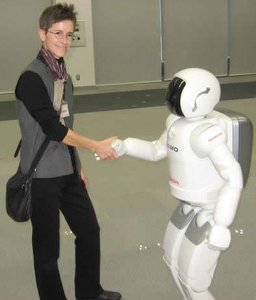 However, if robot-ethnographers are yet to take over, there is fortunately a lot of mixing between anthropologists and robots going on already. Many anthropologists such as Jennifer Robertson (Univ. of Michigan) and Kathleen Richardson (Univ. of Cambridge) are studying the human-robot interaction with fascinating results. It's definitely one of the major fields of anthropology's future!




 Posts
Posts


