Pages

26.1.09

Cyborg cockroach

New Scientist reported on the developments of insect cybernetics, namely the new and improved model of a cyborg cockroach.

"PITY future cyborg insects. As if being remotely controlled by a human isn't bad enough, their every movement may be harnessed to power the electronics that hijack their bodies. This could also extend the length of their enslavement, since the microchips had previously relied on tiny batteries with short lifespans.

Engineers have been attempting to
gain control of insects' bodies for some time, to act as discreet spies or to take advantage of their advanced sense of smell to detect chemicals or explosives.

To do this, researchers implant electrical stimulators that zap certain nerves or brain cells, triggering an impulse that makes the insect move in a desired direction. This process can be controlled by a preprogrammed chip or by remote control
(NewScientist, 6 March 2008, p 40)." Read the rest.

Add a GPS, some RFID and/or 3G technology and a video camera on the thing and multiply it to a few hundred tiny cyborgs using crowd intelligence and we'll have one efficient spy machine similar to the spider robot of Minority Report but half organic. If the cockroaches get really smart we might have one interesting YouTube channel.

Read also Digitoday discussing the article (in Finnish). 1st pic orig. from Foureyesjokeshop.com, appearing in James Sherwood's article Nintendo Wii said to 'attract cockroaches' in Register Hardware news. 2nd pic from BotJunkie (screen capture from the movie Minority Report).

20.1.09

Anthropology Going (even more) Digital

Traditionally cultural anthropology has been about studying distant tribes and low-tech societies outside the Euro-American realm. It took a while until anthropology dared to stay at home and found that there are interesting objects of research also in the scholar's own society.

It took even more time for anthropology to engage in studying the everyday interaction of people and technology. Nowadays, the essential role of digital technologies in global culture is slowly being accepted as a proper subject within the discipline. In my view it should already be part and parcel of anthropology.

Professor Michael Wesch of Kansas State University is a pioneer in digitally oriented cultural anthropology. His view of and approach to modern anthropology was finally recognized when he was awarded the professor of the year 2008 title by The Carnegie Foundation for the Advancement of Teaching. (Wired Magazine discovered him first though when Wesch was given the Rave Award in 2007.) Hopefully Wesch's example will further encourage anthropologists to probe the interesting realm of digital culture.

Check out Prof. Wesch's channel on YouTube and his Digital Ethnography blog. Here's one of the videos that earned the professor the Rave Award.


Pic from Kansan State Univ.

19.1.09

Update on Virtual Church for Kids

My colleague Olli mailed me an update for the virtual church for kids post from last week.

According to Helsingin Sanomat (HS) the chat area of Lastenkirkko ("Children's Church") had to be closed down right after the service had started because of anti-religious and ill-mannered discussion. The virtual church itself has already attracted lots of discussion and debate. Even the number of comments to HS's report added up to 384 this morning.

What a perfect example of the pros and cons of Internet as an open forum for discussion.

Just a thought: would it be an interesting experiment if a religious virtual world would be open for any kind of development - Hindu temples, atheist information booths (with Richard Dawkins' avatar), new age spiritualists, newborn Christian preachers and even Satanists. Then an avatar could browse through all sorts of virtual religions and decide for itself. Click and be saved!


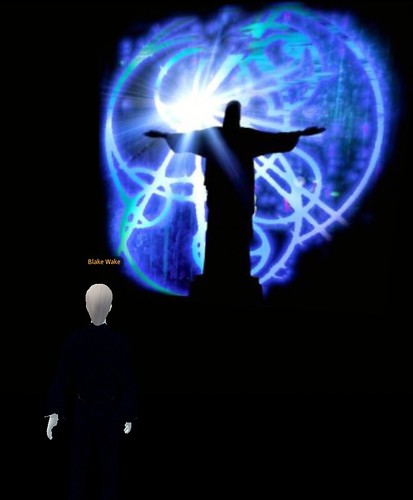
Pic: "Blake Wake Visits Pixel Jesus in a Cave" by Dean Terry in Flickr.

13.1.09

Virtual Church for Kids

Reading Digitoday a few days ago, I noticed how the Evangelical-Lutheran Church of Finland is trying to reach kids in cyberspace by launching a new Flash-based virtual world called Lastenkirkko ("Children's Church").

Like in Habbo, "the hangout for teens", in Lastenkirkko kids can create their own avatar, dress it up and chat away with friends. The church is open for kids' chatter only from 3 to 5 pm when the moderator is present. On other times kids are only allowed to use smileys to communicate with each other.

A juvenile Cyber-Christian can also listen to the stories of Bible, read prayers or just play games. Kids can also have their avatar blessed at the altar, play the organ or visit the grave yard.
Lastekirkko is a laudable move from the Church. It hints towards religion becoming less serious and conservative. Moreover, it is yet another interesting sign of the cultural dynamics of digital age. Virtual worlds are not seen merely as games or something unreal anymore but places of real and useful societal action. It seems like even the most conservative organizations have to have a virtual world entity nowadays. Or maybe the Church has started taking advice from Big Tobacco and catching them while they're young?
But when are the cyborg priests coming?
Pics: the virtual altar from Lastenkirkko, Futurama's robot priest from Futurama and Religion.

9.1.09

Video eyeware and the evolution of audiovisual entertainment tech

Tietokone magazine reported on consumer electronics news among which video glasses caught my eye, so to speak. Sony's executive Howard Stinger and Tom Hanks presented the company's new gadgetry, including video eyewear. Tietokone readers pointed out that although the report seems to claim otherwise, Sony isn't really the first one to present such equipment. Video glasses have been around for some years now and are sold online (see e.g. Verkkokauppa store in Finland and Zeiss' page).


Hanks, Stinger and videogoggles (pic source here).

Sony's video goggles got me thinking about the not so fresh innovation of Sony Walkman (released 1979), or the "Ear Patch Stereos" as they were literally called in Finland. What a technocultural innovation they were! Music that you could take with you and listen to just by yourself! One should remember that hundred years ago music was mainly a collective thing to do. Actually, since the beginning of music itself, people have gathered together to do music - sing together around the fire, in working groups, sorrowful mourning parties, or, more lately in history, gathered together to enoy professional live music performance, and so on.

Then came the record player which better enabled the production of music. The song could now be refined, remade, patched together from separate sections to form a piece best reflecting the vision of its maker (singer, player, song-writer, producer). One could enjoy music without knowing how to sing or having someone to sing for them. One could just listen to records or radio at home with closest friends. With headphones one could enjoy the records by the record player just by oneself.

Finally, Sony Walkman was invented and you could take the music with you where ever you went, and be isolated from your surroundings while being mobile....

...and listen to the music a billion dollar industry had meticulously produced to suit your taste and cultural niche.

The evolution of music tech has developed from enhancing group cohesion to individual isolation. It is one of the many common denominators of a group of individuals sharing same sort of cultural, social and esthetic values. Perhaps nowadays one listens to MP3s in isolation but still feeling connected to peers.

Video glasses are another interesting step in the technological evolution. Now that we have appliances like Nintendo Wii or the like, it won't be long when we can enjoy a walk in the park with friends and not get out of the bed or the couch. We can be physically more isolated but virtually more social and collective.

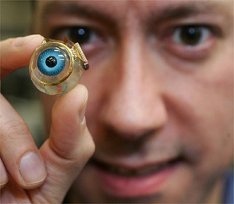
Imagine a bit more distant future, when gadgets like the Walkman (MP3-player) or video goggles become so tiny that they fit inside your eye and ear. Or, to a lot more scifi here, are implanted in your brain. Then virtual would become real (if it isn't already) and physical something as irrelevant as atoms and molecules of a DVD disc of TV screen are today in enjoying a movie.

Pic sources: Sony Walkman from Erlingsi's Flickr page, gramophone from Design Boom, the future eye implant from Übergizmo.

30.12.08

Game PhDs will be produced in Tampere, Finland

According to Tietokone magazine (30 Dec 08), University of Tampere will develop the research and teaching of new media and information technology by fusing two departments (information and hypermedia) into one Department of Information Research and Interactive Media.

The key areas of the new department will be information search and acquisition, game research, social media, information practices in learning and knowledge management of organizations. The master's program of hypermedia was established last autumn but now the game researchers can study right up to PhD.

What a great step for game research - a field that in my opinion is one of the most dynamic and fascinating ones in contemporary new media research.

18.12.08

Lecture: to be a citizen in u-Korea

Yesterday I gave a lecture for the Master's Program of Civil Society Studies at University of Jyväskylä. I talked about the role of the citizen in the South Korean ubiquitous society vision. See the slides here.

Brief points of the lecture:
  • Korea is a country of Big Projects: u-Korea is one of them
  • Technonationalism helps to create a positive spiral of enthusiasm to clear the path towards u-Korea
  • u-Korea vision is TOTAL, meaning that, at least in rhetoric, it changing the whole society in a revolutionary way
  • The emotional value and anthropomorphization of technology are unique to the Korean vision
  • Ethical discussion of the issues of intimacy, control and surveillance in u-Korea is almost non-existent - perhaps because Koreans see more value in the application of new technologies than fear the dangers of it

12.12.08

Humanity+ looking for a leader

Humanity + or the organization formerly known as World Transhumanist Association is looking for an executive director. The association "advocates the ethical use of technology to expand human capacities" and supports "the development of and access to new technologies that enable everyone to enjoy better minds, better bodies and better lives." In other words, they are after the cyborgization of humans. Which to me is just fine and exceedingly interesting as a technocultural phenomenon. In the end, their mission doesn't appear to be essentially different from, say, modern medicine or the visions for mobile communication technology.

It seems to me though that the transhumanists (also called posthumanists) have attracted somewhat negative publicity or at least they haven't always been taken so seriously (see e.g. article in Slate). Perhaps that's why they have changed the name of their association. My hunch is that people not familiar with the association see the prefix trans in transhumanism and think it has something to do with sex change or something else transgressive and crossing borders, which of course many people abhor. In addition to the uncomfortable connotations of the prefix, maybe transhumanists are seen as people who want to turn humans into robots or something else "unnatural".
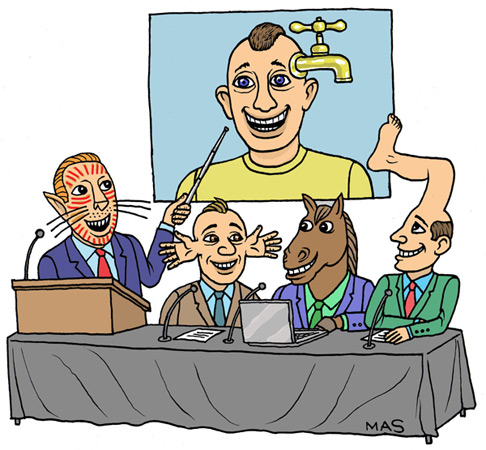
Anyhow, my thumbs are up for the ventures of transhumanists and, despite the danger of making fun of Human+ association and their fascinating agenda, I would still like to present my picks for the job as the next director in charge of expanding human capacities with technology.

Picture sources: the cartoon picture by Mark Stamaty at Slate Magazine; Arnold Schwarzennegger's Terminator at Spiral Focus; Futurama's Bender at Pop Artuk; R2D2 and Kenny Bakes (the actor inside the droid) at Star Wars Movies; Al Gore at BBC News.

Korean Ubiquitous Society Vision: abstract and lecture

I finished the abstract for Culture Abound. It's titled Ubiquitous Society City - Korean Future Vision of Humans and Technology in the Urban Space. Like I discussed earlier, in the final article (deadline in May 2009) I will discuss the Korean ubiquitous society vision and the interrelation between humans and technology in an urban context in it.

Next I will do a little preparing for my lecture next week. The theme of the lecture is related to the abstract as I will talk about the role of a citizen in u-Korea. (More about my lecturing schedule.)

10.12.08

A rough rough draft on future Korean school ready, next on u-city

I have just sent a rough draft of my manuscript on Korean ubiquitous society vision and the role of education in it to the editor and will wait for feedback. As always, I'm suffering from the acute syndrome of not having done enough but feeling happy about getting rid of the job for a while. Fortunately, I have until the end of January to make changes after hearing from the ed.

Next I will probably write an abstract to Culture Unbound, a new journal that has a special issue of The City coming up. I think I will try writing something about the city as the primus locus in the vision of ubiquitous society.

Synergy is the keyword when writing articles. One foundation of data carries a long way.

8.12.08

Crashing laptops, infodemics and disconnections

My laptop just crashed and the PC service of our university couldn't rescue all the gigabytes of data that vanished in the air. Fortunately I have taken backup copies of most important files, so it was not a catastrophe. The service guy told me I'm among the lucky 7 % who as suspicious enough not to trust their laptops.

The curious thing is that part of me is relieved. Although I lost a lot of valuable information, like interesting articles, links, pictures and video, I'm kind of happy it's not there anymore. I will probably have to re-do many things like search for the lost articles but I will do it ad hoc, bit by bit as I come across the need for a particular piece of information.

It's old news that we live in a sea of information. Or data. Or knowledge. Whatever we want to call it, the amount of it we possess and store in our lives (in computers or filter and manage online) has grown exponentially. The problem is to get the real thing, to pick up the essential info and the significant stuff from the hurly burly.

To a techno anthropologist this brings forth a great object of research titled All the Information You Have to Deal with. An ethnography into personal data management would ask questions like how you deal with the data, what is significant information, what is fun, what is personal, what is shared (with whom). Feel free to steal the idea. Although it seems like somebody is already teaching a course about it in Indiana.

In my opinion, too much data in one's life is a sign of infodemics. However, I came across some news (read here too) about the government of S. Korea and their definition of infodemics. Like most governments of the world, Korea is worrying about its citizens being exposed to the the wrong kind of information, the stuff that gives you false conceptions of the government. This phenomenon they call infodemics, a sort of pandemic form of disinformation.

An example of infodemics was the Korean online/offline protest movement against US imported beef. The protesters feared mad cow disease but to the government it was all about anti governmental disinformation. To save the citizens from infodemics in the future the government is working on a new Cyber Defamation Law.

Tangential to my laptop crashing and infodemics is Jan Chipchase's article about opting out. Chipchase discusses how he doesn't want to be constantly located and updated in someone's network. In today's tech society he and many other people enjoy going to the pub around the corner where they are simply not in reach, and they "make a conscious effort to disconnect." Who knows, perhaps the word disconnect will be synonymous to holiday in the future - although for many today it still means little less than social disaster.

1.12.08

From scifi to Korean future school

I don't read or watch much of it these days but still I'm a solid fan of science fiction. By scifi I don't mean so much the fantasy oriented stuff like Star Wars or The Fifth Element although they are fun to watch. To me, the real scifi is the hardcore genre represented by Contact (written by Carl Sagan) or 2001: A Space Odyssey (by Arthur C. Clarke).

In my opinion HC scifi is related to anthropology as lots of scifi literature deals with interesting sociocultural configurations albeit in an imagined location (in another planet) and/or in another time (usually the future). I also tend to get a lot of ideas and inspiration from scifi that helps me in my research. Or, could help me if I got around to develop the ideas and make them materialize on paper.

The last piece I read was Philip K. Dick's Do Androids Dream of Electric Sheep (by Philip K. Dick, filmed as Blade Runner) that described a future society with androids used in the colonization of distant planets. That kind of future might not be so far ahead. Take a look at the BigDog robomule developed for the military by Boston Dynamics or read about the Robot Code of Ethics that is being drawn up by the S. Korean government to prevent the human abuse of robots - and vice versa.

To get to the initial point that prompted me to write this... as I posted before, I'm in the middle of writing a chapter about the school of future in Korea. In other words I'm trying to figure out what going to school will be like in 30 t0 50 years from now in Korea. Today I watched a video about Cyber Home Learning System developed in Korea. In addition to enhancing the quality of public education, the system was (and is being) built to cut down private tutoring expenses and reduce education gap.

It is widely known that Koreans are big spenders on private tutoring, and private teaching makes up a big proportion of education in general, which makes most learning in Korea to be somewhat an elite hobby. No money means half the teaching. However, the Cyber Home Learning System is meant to alleviate the problem as it is (and will be) cheaper to get the software and use the system than to pay for private tutoring.

A student would access the system at home and study by him/herself. This fits the general Korean vision of future education, emphasizing individualization and domestication of learning (see an article about it). Whether this is a desirable path or not is beside the point here. In my opinion it is just another step towards the future network society where a significantly larger proportion of our lives happens on the net. It will surely change our culture and our experience of being social - as it has already. Such interesting times for an anthropologist!

Together with the development of nanotechnology, implant hardware, virtual software, massive "googleization", cybernetics etc. the future life of a online human will be so different that contemporary scifi and transhuman visions might turn out to be hopelessly lame and conservative. Uploading, sharing and downloading consciousnesses, copy-pasting them into cybernetic organisms, creating "googles of consciousness" may be only a prelude to a way more scifi future. The sweet thing is that we have no idea.

Today, I imagined a Korean elementary school pupil of the future, hooked into a learning software in his room, downloading data about the world into his mind, meeting his friends online and perhaps a few times a month or a year actually doing something with them in "meatspace" instead of cyberspace. What will "really meeting" someone mean in the future, when almost everything is online, when we meet our friends in the future facebooks and twitters, interact with people mostly virtually. Surely this is not a new question and others also have thought if "meatspace" dates will be considered as primitive, suspicious, conservative and even less authentic.

However, the future school of Korea, the kid in his home learning center, reminded me of Isaac Asimov's The Naked Sun published in 1957. In the novel there is a planet called Solaria where people are virtually hermits and don't meet each other physically. Even the idea of meeting someone face-to-face is considered as repulsive or disrupting intimacy. However, the Solarians do spend their social time chatting with the hologram representations of their friends. And when the Solarians are young, the are allowed to interact with other kids in meatspace but are given a designated location of solitude when they reach a certain age. In their own quarters they spend their time learning, working, interacting with friends in holograms and being served by robots - and panicking if they happen to really meet someone.

Asimov was pretty witty already 50 years ago.

IBM predicting the future

Digitoday reported on IBM revealing five great innovations of the near future. I surfed to IBM's report published in November 25 and read about the innovations "That Will Change Our Lives in the Next Five Years" and change the way we will "work, live and play."

The Fab 5 are:
  1. Solar energy panels (or, film) so thin (and cheap) you can paint or print them almost everywhere.
  2. Everyday gene analysis that will help you (and your doc) tune your habits according to your physiological strengths and weaknesses. All this for less than 200 USD.
  3. Talking to the web and it will talk to you, so you don't have to read/write. IBM says voice recognition tech is getting better and will become hugely popular soon, especially in the developing countries -and perhaps among people too busy to type.
  4. Digital shopping assistant helping you in the fitting room and connecting you to your social network for fashion advice.
  5. A memorizer to record, store and analyze the "details of everyday life". It's a smart gadget with videocam and mic that will "record conversations and activities. The information collected will be automatically stored and analyzed on a personal computer."

Needless to say, solar energy is surely a smart move but as for the gene analysis innovation sparked some discussion at Digitoday as some wondered whether insurance companies and potential employers would start requiring genetic evaluations of their clients/employees. As one commentor said, it brings in mind the movie Gattaca, a dystopian view of the future when citizens are classified according to their genetics. Then again, if it can help people to live a healthier life...

The voice-orientation of IT applications is an interesting path and, from a techno-anthropologist's view, would probably bring about fascinating changes to how people relate to computers.

The digital shopping assistant didn't strike me as a huge innovation although it would be nice to have someone reliable to virtually warn me against the cool Hawaii shirt I'm about to buy. But to include it in top 5 innovation of the future is exaggeration.

A memorizer would come in handy if it was handy. If it was tiny, almost invisible and could really filter out the irrelevant data from the relevant (which I can't do) and presented it to me neatly on my PC, laptop or cell phone, then maybe I would buy one. The hackers would have loads of fun too hooking into people's memorizers.

Read the whole IBM press release here and the Digitoday article here (in Finnish).

28.11.08

Weekend work

Now back to home to enjoy the weekend with the family. As for work, I will try to avoid it although for a technologically oriented cultural anthropologist, it's everywhere. Hopefully the maximum for me will be to read a book about robot I bought the other day. It's light enough and has a lot of pictures!

Future lectures

Here's my updated schedule for lecturing:

Plus I'm the examiner of Indian Studies (part of Intercultural Studies) at the University of Jyväskylä Department of Communication and Language and Communication in East and Southeast Asia by the Finnish National University Network for East and Southeast Asian Studies.