Pages

14.10.09

Virginity through technology

In Helsingin Sanomat today, a Finnish author/columnist Riku Korhonen discussed news about Egyptian lawmakers wanting to ban a recent biotechnological innovation, the fake hymens made by a Chinese company Gigimo. New York Post (5 October 2009) describes the product:
The Artificial Virginity Hymen kit, distributed by the Chinese company Gigimo, costs about $30. It is intended to help newly married women fool their husbands into believing they are virgins - culturally important in a conservative Middle East where sex before marriage is considered by many to be illicit. The product leaks a blood-like substance when inserted and broken.
Riku Korhonen is not sure what to think of this "innocence manufactured in Far East." He sees the bodies of the women relying on the product as a battle ground where Western sexual liberalism and traditional religious moral code collide with the production lines of the ascending East Asia. In the product, Korhonen thinks, the animal instincts of humans are combined with a technocratic ability to solve problems.

The fake hymen is a great example of a technological innovation with a high load of cultural meaning. How much the product is improving women's rights is another thing. Perhaps it is good that women in male-hegemonic cultures are now more able to have premarital sex and quietly rebel against the traditional moral system. On the other hand, perhaps using the product is in a Foucauldian way reinforcing male domination as women are accepting the men's rules of sexuality by circumventing them.

Then again, to set the phenomenon in a larger context, there is nothing new under the sun. People around the world have been and are using all sorts of technologies from small things like going to the gym, using make-up and shaving to more radical operations like cosmetic surgery to make themselves more desirable to the opposite (or same) sex. What's a bag of protein in that complex web of sexual culture?

Picture source: Artificial Virginity Hymen sold by Gigimo.

29.9.09

Participation Culture, Creativity, and Social Change

I happened to come across the 10-minute YouTube version of the inaugural lecture of David Gauntlett, Professor of Media and Communications at the School of Media, Arts and Design, University of Westminster and the author of Media, Gender and Identity (among other things). Professors of the world, more stuff like this please!


For more information about Prof. Gauntlett's work, see e.g. Wikipedia. Also check out his complete list of publications.

4.6.09

Anthropological Explanation for the Financial Crisis

The "Innovation Guru" of BusinessWeek, Bruce Nussbaum discusses the cultural side of the financial crisis. His idea is that the conceptual leap from "gambling" to "gaming" in describing the phenomenon of risking money was essential. Check out the video (3 min 34 sec) here!

2.6.09

South Korea: Towards a Ubiquitous Mediascape

Last week I finished a manuscript to appear in Turo Uskali's (ed.) forthcoming volume titled Media Futures. The text is sort of summarizing piece of my Korean Media Culture research project (2006-2009) funded by Helsingin Sanomat Foundation. If you're interested enough to read the manuscript please feel free to comment!

27.5.09

The Anthropology of Online Poker: A Research Plan

Last week I posted about my future project concerning the culture of online poker, and promised to tell more about my plans. So, here is a summary of my research plan.

I'm interested in four themes of online poker culture, and the hegemonic discourses within it. The themes are 1. the players, 2. the advertising, 3. the counterforces and, finally (not really a theme) 4. a holistic ethnography.

1. The players of online poker
In studying the players I am interested in to what extent the players feel unity with other members of the online poker community and how they uphold this unity. Moreover, I am interested on how the players negotiate their playing to fit their personal historical narrative. I assume the players form a subculture that has to be adapted to each one's personal microculture. On the other hand, the players have to negotiate the status and the position of the game in the wider system of cultural meaning. How exactly this happens is something I'm going to find out.

To study the players I will interview 10 to 20 Finnish poker players, pros and amateurs. In addition to interviews about the meaning of online poker, I will practice participant observation which, in this limited sense, will mean observing players at their gaming interface and asking them to explain the flow of the game and the significances they see in the process.

2. Online poker advertising
The online poker ads seem to appeal to masculinity, sexuality, excitement and the promise of luxury. My purpose is to analyze the hegemonic discourse in advertising and reconstruct the image of an authentic poker-player in that discourse. For this I will go through various poker sites and magazines.

3. Counterforces of online poker
Online poker has evoked a lot of resistance in the media. Especially the well-being of young players is often worried after. It seems like it is characteristic to the resistance to represent players as in jeopardy and constantly on the verge of personal devastation. Thus, I want to analyze the discussion about online poker and find out about the rhetoric and the discursive means the opponents of online poker use to strengthen their arguments.

4. Holistic ethnography of online poker.
Finally, I will attempt a holistic ethnography which means a descriptive account of different infra- and superstructural elements of online poker culture/society. For this I will draw on the results of the previous three themes as well as the popular and academic literature and websites on the subject. Briefly put, I will try to write a straight and informative general description of online poker culture.


If you have anything to comment or suggest
feel absolutely free to post a comment or email me!


Pic sources: Bronislaw Malinowski here, poker table here.

18.5.09

The Anthropology of Online Poker: A Polemical Prelude

Nothing can substitute the experience of the game, the psychological eye for the game and the ability to manipulate the opponents. Instead of hesitating and contemplating whether or not to dare, it is extremely important to just jump straight into the game.


"This is how you start playing online poker", From Nettipokeri.info,
(transl. from Finnish by JJ)


Online poker is a game for the young men living in the world dedicated to experience. As a cultural phenomenon it is an interesting mix of cyberspace, hard work, economics and nomadic culture. It is against and for protestant ethics. It is a Darwinist trip. It is about the Baudrillardian hyperreal and the everyday personal Realpolitik. It is a game that is work and pleasure, where men battle over glory.
The folklore of online poker has its geniuses, foxes and plain losers. Big players move big money for a living and luxury. Small players play to smuggle a little excitement in to the Everyday. The advertisement draws on and renews the heroics and the discourse of Man of the Game, not ignoring sex appeal. To play bravely in a dynamic and exciting environment keeps one's masculinity alive.

On the borderline of poker culture there is the counter-discourse using moral panic to limit the reckless of the cyberspace, to tame the characters shifting around the liminal spaces of welfare state, going against traditional values of work, responsibility and family.

From these polemical grounds I will start my next research project next fall, studying online poker culture with the tools of anthropology and funded by the Finnish Foundation for Gaming Research. I will write more about my research plan a bit later.


Pic above is an ad of Full Tilt Poker at Poker Magazines news site, the pic below is from Full Tilt Poker site.

12.5.09

Notes on ICTD2009 conference

The 3-day conference on Information and Communication Technologies and Development (ICTD2009) at Carnegie Mellon University, Doha, Qatar was an intensive package full of, well, information and communication.

As I've written before, ICTD is a new and vast field in the making and it seems like the only thing its scholars, practitioners and observers agree on is that it is a field that focuses on the relationship between technology and the communities of developing countries.

In Doha, scholars of economics, sociology, anthropology as well as engineers, NGO representatives and civil servants all defined their work as ICTD. Not surprisingly, the definition, purpose, visions and rules of ICTD became a common topic in Doha. "What is ICTD?" was a hard question to answer, particularly when someone else asked you "What is development?"

The lovely organized chaos within the field just makes the whole constellation more interesting. The fact is that whatever the definition of ICTD is, it doesn't stop people from doing important research, grass root work and policy planning. The dangerous thing for many, it seems, is businesses using ICTD as a label to improve their sales. For many, that's just fine too. If people benefit, there's no beef.

But what does "benefit" mean? That's actually a question that was asked many times. How to evaluate ICTD's impact? What is good ICTD? The basic challenge of ICTD seems to be to come up with a good ICTD innovation. And, further, to measure the success of an innovation. Finally, if there is a successful innovation, how to make it work somewhere else.


For a Finnish-language conference report (8 p.) of ICTD2009, click here.

7.5.09

Yasukuni, Japan and Korea: A Paper

Tomorrow I will join the Asian Political Thought seminar organized by Prof. Pekka Korhonen of Political Science at University of Jyväskylä. I will present a short paper about an exceedingly interesting phenomenon loaded with symbolism and nationalism. It's the Yasukuni Shrine issue and I will discuss how it is presented in Korean online media. Here's an excerpt for a prelude:
Korea was occupied for 35 years by the Japanese Empire, from1910-45. It is a history that still defines what it means to be Korean. On August 15th of 2006, the Japanese Prime Minister Koizumi visited Yasukuni Jinja, a shrine in Tokyo dedicated to the souls of soldiers who had given their lives for the Emperor. The year marked the 61st anniversary of Japan’s surrender and Korea’s liberation in World War II, and Koizumi was the first prime minister in twenty years to visit Yasukuni on that particular day. The visit sparked strong reactions in Korean media and, created a related stir Korea’s political sphere. Indeed, Koizumi’s move prompted the South Korean President Roh Moo Hyun to postpone his visits to Japan for a year.

In the Korean media sphere, Koizumi’s Yasukuni visit re-animated the figure of Japan as it existed during World War II. For Koreans, what may have been a small step for the Japanese Prime Minister, was seen as a trampling over of the Korean nation, and signified Japanese disregard to Korea’s past suffering. In this paper I briefly present and discuss some of the Korean reactions to the Yasukuni Shrine issue in 2006. I consider how Korean online media represented the case to its foreign, English-speaking audiences and through that process, constructed and renewed a Korean national identity.

Read the whole paper here. For a longer version in Finnish, see this link. All comments are welcome!

24.4.09

22 Why Questions about the Web

Ever wonder why you can do certain things on the Internet but not something else? Or, why the web is like it is although it could be different/better - or could it?

Alexander van Elsas is a new media blogger and the CEO of Glubble, an online activity center for families. In his blog post, Alexander has asked 22 questions about the web under six different categories, which are:

1) Networks and destinations
2) Personality and identity
3) Data
4) Privacy
5) Business models
6) Behavior.

Some of Alexander's questions are rhetorical, some very easy to answer and some have no meaningful answer. Nevertheless the questions per se seem to tell us a lot about the web as a new way of being and about people's attitudes towards it.

My favorite questions on the list of 22:

5. Why am I forced to be fragmented across the web, instead of having one presence that can connect anywhere?
7. What is or defines my online identity? Am I my profile, my interactions, my data?
11. Can data lead to demand, or does it only take care of supply?
20. Why would we want to have thousands of friends and interact everywhere?
22. Why do we spend more and more time online while real life passes by so quickly?

See the rest of the questions here. (One commenter even had his staff answer the questions. Check them out!)

Pic of Alexander van Elsas from his blog.

13.4.09

Prelude to ICTD2009 Conference - Defining the Discipline

A group of researchers and I are planning a project on the use of mobile communication technology in several developing countries - my site being Tamil Nadu, India, where I used to do ethnography for my PhD dissertation.

Our project could be defined as belonging to the field of ICTD or Information and Communication Technologies and Development. As one might guess, it is a broad field concerning developing countries and the use of new technologies in them. To get to know more about the field, I will be attending ICTD2009 next week in Doha, Qatar.


There's another abbreviation, ICT4D, that has more or less the same kind of meaning than ICTD but perhaps with a slightly different orientation. In his blog post ICT4D, ICTD, or what? Chris Coward discusses the definition of the discipline.

Chris says ICT4D usually connotes "the application of (primarily digital) ICT to interventions that have an explicit developmental goal such as health, education, government transparency" etc. and it has a tendency to ignore conventional development goals or research about all kinds of non-developmental uses of ICT in the developing world context.

For example, according to Chris his colleague's paper about depictions of computers in Indian cinema proposed for ICTD2009 was critiqued for not fitting in the discipline. To Chris this is regrettable as,

"it is incredibly relevant to understand how the computer has become a symbol of aspiration within a society, how that symbol has changed over time, is the computer used for good or ill, what effect this has on people’s views of technology’s promise or pitfalls, and so on."
Chris goes on to compare ICT4D with ICTD which has a broader scope not excluding more research on how ICT is used in developing countries. ICTD doesn't necessarily have to have a developmental goal.

In defining the discipline that focuses on ICT in developing countries there is also the problem of defining "development" and, as Chris says, the need to discuss the meaning of lumping "countries into developing or developed buckets". Also, there's the big question of whether ICTD is a field at all, and if so, what should it be eventually called. Chris says he will take these issues up in an ICTD Curriculum Workshop at Doha. I'm sure there will be at least one interesting discussion at ICTD2009!


Pic sources: Indian monk with cell phone from W3C; ICTD2009 logo from the conference website; book cover of ICT4D: Information and Communication Technology for Development from Cambridge catalogue.

8.4.09

Could a Robot Replace an Anthropologist?

LiveScience (2 April 2009) reported about Adam the Robot Scientist of Abersystwythin University succeeding in creating and confirming a scientific hypothesis without human intervention. Adam predicted that in baker's yeast there are certain genes for specific enzymes encouraging biochemical reactions. The robot then ran experiments in its laboratory to test the hypothesis and analyzed the results.

Although hypothesis-producing robots are an "age-old" invention (since 2004), Adam is special because it can handle independent and automatized laboratory work. According to the computer scientist Ross King, in the future robots will become more widely applied as assistants in the routines and less-interesting tasks of laboratory scientists.

Now when do we anthropologists get our hypothesis-producing robots?! I would love to co-write an article with iMalinowski or Android Appadurai. Or, to get back on Earth, if a cyborg anthropologist is a tall order, it would definitely be interesting to use a robot in the field of, say, urban ethnography.

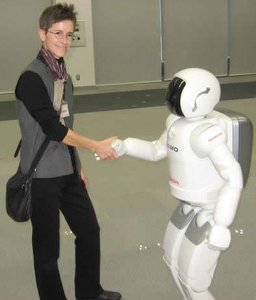
I can easily imagine an interactive robot such as the ones wondering around Incheon Airport, South Korea (see pic left) programmed to do participant-observation and interview people in a public space. Obviously, serious scrutiny of the method would be required but if low-cost and discreet robots were to be produced in the future, I'd see no problem in hiring a few. It would be fun too!


However, if robot-ethnographers are yet to take over, there is fortunately a lot of mixing between anthropologists and robots going on already. Many anthropologists such as Jennifer Robertson (Univ. of Michigan) and Kathleen Richardson (Univ. of Cambridge) are studying the human-robot interaction with fascinating results. It's definitely one of the major fields of anthropology's future!

So, if for now I can't enjoy the help of an ethnographer-robot I can at least study the emerging field of humans mingling with robots.


Read the LiveScience article on Adam here. See also the Mbnet article on the same in Finnish. Pic sources: Robot at Incheon Airport by Jukka Jouhki; Robertson with Asimo from antropologi.info (article orig. from The Daily Texan).


27.3.09

Paleo-Future or the Futures of the Past

Microsoft Office Labs has produced a montage video about what information technology will be like in 2019. In my opinion it's a neat and inspiring video but like any vision of the future, it has little to do with what the world will actually be like. The future just sort of shies away from most predictions, and the visions end up telling more about the contemporary world than the future.

Reading the the comments discussing the MOL video at iStartedsomething I myself started to rekindle my long lost idea of doing research on the past futures. Or the futures of the past. Then I came across Tim R. Mortiss' blog with some links to websites and blogs discussing the theme.

Paleo-Future is a blog that takes "a look into the future that never was". Paleo-future as a concept means a historical look at the visions of the future. The blog has plenty of interesting material on its subject. Here's a few pictures (click for hyperlink to original post) of how the future was imagined in the past.

"Going to the Opera in the Year 2000" (1882) - Of course on the all too non-existent flying cars!

"Everyman's Folding Auto" (1939) - Not yet, but we do have the folding bike though.


"Game Parlor in the Future" (1982) - Pretty perceptive story actually!


"Tomorrow's Kitchen" (1943) - No pots and pans anymore!

"The Future of the Helicopter" (1955) - Handy, eh?


Other interesting posts in the blog include: Postcards Show the Year 2000 (circa 1900), Collier's Illustrated Future of 2001 (1901) and Movies to be Produced in Every Home (1925). Check them out!

You can also browse through Daily Motion for paleofuturistic video clips. See, for example, The Electronic home (late 1980s) commercial with "computer-television" controlled with a joystick and "computerized yellow pages". The video is produced by a telephone company and they predict that information services through the "computer-television" will be as natural as driving a car in the future. Not bad, eh?

Or check out Magic Highway, a clip where an American vision of traveling by motorcar is presented in 1958. In The Future is Now (1955) electronic photography, video telephone and electronic music synthesizer are visioned.

And where's my jetpack already?! See the Jetpack Dreams trailer of a book by Mac Montandon (see also the Pale-Future post about it).

"How would you feel if those futurescapes of fifty years ago materialized today?" asks William Gibson. Read his essay at American.Heritage.com.


Pic sources as sited by Paleo-Future blog: Lithograph by Albert Robida in La vie électrique; The November 26, 1939 issue of San Antonio Light; a 1982 issue of Electronic Games magazine; the April 30, 1955 issue of Pacific Stars and Stripes (Tokyo, Japan). More about Microsoft Office Lab's future visions here.

26.3.09

Random notes from Salzburg

The Digital Memories conference (Salzburg) is over. Here are some of my scattered notes about new and old ideas discussed during or evoked by all the interesting presentations.

Anna Reading talked about the global unconscious and globalized memories. During her presentation someone mentioned that it's funny how before people were afraid of forgetting important things but nowadays people worry about some entity remembering everything they do.

There was also discussion about how to define connectivity? We are being told we live in a connected world. But exactly how much mobile phone or internet use does it require? How many hours or how many connections? Or how much speed? For being connected, is it enough to use the cell phone every now and then for a phone call and an sms or is heavy-user multimedia attitude needed? Does one have to practically live online in order to earn the right to be called "connected"?

One of the concepts that stuck to my mind was relocalized memory. It means the situations where a population of a nation/group migrates away from "home land" and redefines or recircumscribes the collective identity which is then imported back to the "home land" to reconstruct and reinforce the imagined community. This, at least, is my interpretation of the concept. This has happened in the case of N. Ireland: the Irish migrated to USA, re-interpreted Irishness and produced an image which was then taken as a model by the people N. Ireland.

In my view, something like relocalization has happened to phenomena like Hinduism in the 19th century (exported to the West & imported back to India), Zen Buddhism in the 1960s (Japan --> US --> Japan) and many other globalized cultural elements that, in the source location, have been redefined according to a more hegemonic model.

After Anna's presentation there was also discussion about premediation (cf. Foucault's discursive archive) which was a new one for me, meaning media producing contents that will give us guidelines on how to react to a future event.

Andrew Hoskins mentioned T. H. Eriksen's idea of vertical stacking of information which happens, according to Eriksen, when

"growing amounts of information are distributed at growing speed" and "it becomes increasingly difficult to create narratives, orders, development sequences. The fragments threaten to become hegemonic. This has consequences for the ways we relate both to knowledge, work and lifestyle in a wide sense. Cause and effect, internal organic growth, maturity and experience are under heavy pressure in this situation." (p. 45 of Eriksen's Globalization: The Key Concepts.)
Alberto Sá from Minho University, Portugal, mentioned a concept I found very interesting. Alberto used the concept of semantic resolution and I immediately thought it could be heuristically used in, say, cultural anthropology describing the different levels of understanding of foreign people. Imagine, for example, a Finn trying to make sense of the Russian culture. If the Finn has low semantic resolution he sees Russians as all-the-same monolithic entity without any heterogeneity. But when the semantic resolution grows you are able to see more "cultural pixels" and thus detect nuances in the object of your gaze.

Owen Kelly's side note was also interesting: when people complain about new technologies weakening the mental capacities of humans, it's good to remember Socrates and how he talked about the alphabet causing forgetfulness and ignorance in people. In addition to this, Owen wondered about how to define memory and what exactly is the unit of memory. What ever it is, memory is something that happens in the present, not in the past. Remembering is like making path from the present to the imagined past. It's not about bringing some past issue alive but more like recreating past in the present.

Olivier Nyirubugara's presentation on hyperlinking made me realize how political hyperlinking actually is. Think about it - it's actually quite a powerful micro-political tool. If you have a popular website or you are a specialist of a field with a blog, by producing or not producing links you are communicating values and appreciations.

Finally,Jeff Rothenberg was quoted:


Digital information lasts forever or five years
- which ever comes first.


Pic sources: top pic from New Media, pic below from The Boston Channel.

11.3.09

Going for Digital Memories

I will spend next week in Salzburg and attend Digital Memories conference. My paper titled "Dokdo Island Dispute: Korean Reconstruction of History and National Identity in User-Created Content Media" will introduce Korean cybernationalism, or, the way new user-created media such as YouTube are used for nationalist purposes. I will present my paper at Session 7: National Identity and Memory in the Digital Age on Thursday, March 19, 2009.

There are plenty of interesting conference papers available here. A few of them caught my eye:

Other papers include titles such as "The Global Unconscious and Globalised Memories in the Digital Age", "Can New Technologies Shape Metamemory?", "Memi, Building an Extension of Memory", "Rewriting Literary Past in Digital Age", "Digital Memories of High-Tech Tourists and Travelling Media". Check them out here.

5.3.09

Copy Right or Wrong - The Pirate Bay Case and Mind Games

The Pirate Bay is a Swedish website that tracks BitTorrents. It has to do with sharing files.

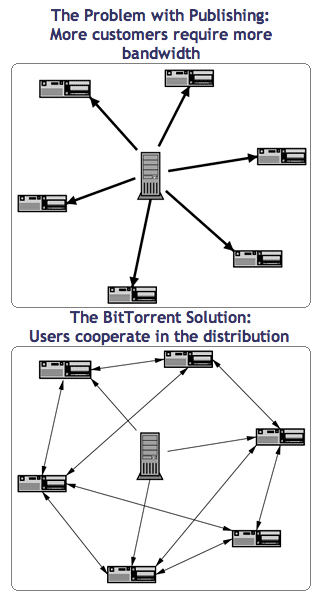
A traditional model of file sharing has Mr. X downloading a file from a server. If many people are after the same file, the server must have a bigger capacity.

A BitTorrent is a protocol that makes sharing files faster and lighter, and it works like this:

Mr. X wants a file likeavirgin.mp3. He goes to a website that tracks BitTorrents. He enters "Like a Virgin" in the search box and gets a list of the available torrents. He clicks one of them and starts to download likeavirgin.mp3 simultaneously from numerous individual sources. While downloading the file he automatically starts to share it with other users too.
In The Pirate Bay everyone can upload and download torrent files. In other words, Mr. X can inform the website about a link that leads to his file likeavirgin.mp3. Other people may inform the website about the same file too. Hence, one link (torrent) in The Pirate Bay may lead to many similar files. In a way The Pirate Bay is a directory of links to individual files. The website per se does not produce any files other than the torrents. No copyrighted material exists in the website's server.

Media companies such as Sony and Warner Bros. have sued The Pirate Bay for copyright theft. Or, to be more exact (as the BBC reports) the owners of the website are accused of "promoting other people's infringements of copyright laws" and the movie, music and video games industry are seeking for compensation (10.6 million euros) "in damages and interest for losses incurred from tens of millions of illegal downloads facilitated by the site." The Bay people, on the other hand, say it's like being sued for making cars that can go faster than the speed limit.

The court case seems to be about two ethical issues. The more obvious is about copyright and the other is about responsibility. It seems like both parties agree on the definition of copyright being "a form of intellectual property which gives the creator of an original work exclusive rights for a certain time period in relation to that work, including its publication, distribution and adaptation." No one thinks Mr. X is allowed to upload or download likeavirgin.mp3.

The big question is whether The Pirate Bay is responsible for publishing a directory of links of which some lead to likeavirgin.mp3 in Mr. X's, Y's and Z's personal computers and, thus, to copyrighted material.

Hard to decide?
Let's try mind games.

Imagine a library with some of its clientele photo-copying some books and thus infringing copyright. Then imagine a book publisher suing the library for aiding violation of copyright. Who do you think would win the case? Would you rather recommend the publisher to sue the copyists instead of the library?


If you would still prefer suing the library, let's go further in the mind game.

Imagine a building just like a library but with the exception of there being no books in the building. Imagine Mr. X. going into the building and asking the librarian if he knew where to find Jonathan Zitrain's The Future of the Internet - And How to Stop It. The librarian would take a look at a list and give Mr. X. the address of Mr. Y. who has the book. Then Mr. X. would go to Mr. Y. and photocopy the book - and infringe copyright.

Would you still charge the library?
You would?
OK then.

Imagine the same library without the books and without the librarian. The only thing that the library would contain would be a notice board where people could post their addresses and the titles of text they possess, whether they be self-written poems, theses, shopping-lists, jokes or copyrighted books. Then imagine Mr. X. going to the notice board and finding the address of Mr. Y. with Zitrain's book.

You could still think the library is the one to blame. And that would be perfectly sound. Perhaps a lot of your judgement would depend on the answers to these questions:

  • How many of the texts listed in the notice board are copyrighted?
  • Is the library aware of the potential copyright infringement enabled by their notice board?
  • Is the library making money out of it?
  • Is the sole purpose of the library to aid copyright infringement?

Or you could as easily make up different kind of questions leading to the opposite moral judgment. You could ask...

  • Is the library itself making copies of copyrighted material?

...and answer no, it is not - and call the case closed.

Eventually copyright is a cultural phenomenon par excellence. It has always been an intriguing ethical issue and the digital age makes it even more so. It seems like the rapid progress of digital technologies makes it very hard for strict copyright to exist. Especially if the counter-sharing technologies and the law-making processes are not able to keep up with the development.

Imagine the year 2050. Will we laugh at the ancient practice of having to pay for likeavirgin.mp3 as all possible public digital data is accessible free by anyone or will the digital pirates be the last outlaws of the world hunted down by the all-seeing media industry/police force complex?


Pic sources: The two modes of file transfer from Bruce’s Journal, the pirate bay symbol from P2P ON!, the library from Southeastern Illinois College, "Captain Copyright" from http://media.canada.com/canwest/143/, Communication from Equalitec.